
If you have used Google Ads before, you may be familiar with Search campaigns where you choose keywords and create text ads that appear when people search on Google. Performance Max works differently.
Instead of focusing on one Google Ads Channel, Performance Max allows Google to use a single campaign across multiple channels and use AI to decide where and when your ads should appear.
The goal is simple: give Google your business goal, budget and advertising assets, and let its system find opportunities to generate conversions or conversion value. But what does that actually mean for your business?
What is Google Performance Max?
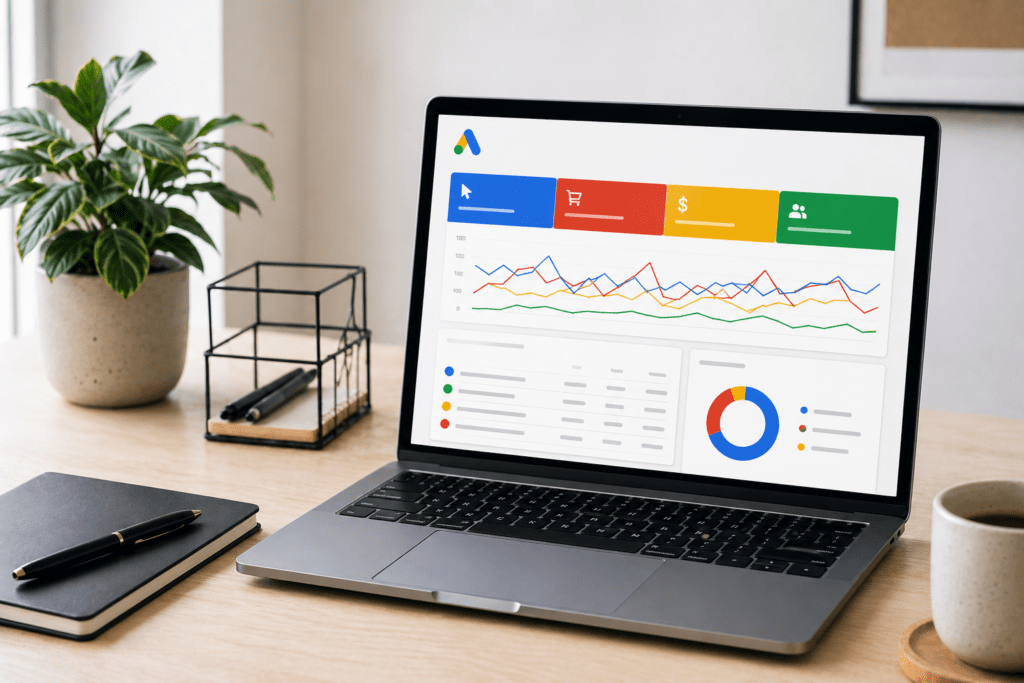
Performance Max is a goal-based Google Ads campaign that can show advertising across Google’s advertising inventory from one campaign.
Depending on the campaign and the assets you provide, ads can appear across:
- Google Search
- YouTube
- Google Display Network
- Discover
- Gmail
- Google Maps
- Search partner sites
Google’s current Performance Max channel reporting also includes Shopping inventory when product data is being used.
Rather than creating a separate Google Ads campaign for each of these channels, Performance Max allows Google’s AI to decide which opportunities are most likely to help achieve your campaign goal.
For example, someone might search Google for your service in the morning, watch a related video on YouTube later that day and then visit your website from another Google placement. Performance Max can use signals from these different environments when deciding where to show your ads.
What types of ads does Performance Max run?
Performance Max does not use one single type of advert. The ads are created from the assets and information you provide and can take different forms depending on where they appear.
Search ads: Your text assets can be used to create ads that appear when people search on Google. You provide headlines and descriptions, while Google can combine these assets and select versions based on the search and other signals. Performance Max can also use information from your landing pages to generate additional text assets when text customisation is enabled.
Display ads: Your images, text and other assets can be used for ads across Google’s Display Network. These ads can appear on websites and apps that are part of the Google Display Network.
YouTube ads: Performance Max can show ads on YouTube. If you provide video assets, Google can use them as part of your campaign. Depending on the placement, YouTube can also display other types of advertising assets. If you don’t provide video, Google may be able to create video assets from the other assets you provide, depending on the campaign setup.
Discover and Gmail ads: Your campaign can also reach people through Google’s Discover feed and Gmail. The format changes according to the placement, which is why providing a range of suitable images, headlines and descriptions gives Google more material to work with.
Maps: Performance Max can also show advertising on Google Maps. This can be useful for businesses that rely on customers visiting a physical location.
Shopping ads: This is where things get interesting for online retailers. If you sell products online, you can connect your Google Ads account to Google Merchant Center and provide a product feed.
The product information can then be used to create Shopping ads containing information such as the product image, name, price and store name. So, no, you don’t need to connect a store to use Performance Max.
You need Merchant Center when you want Performance Max to use your product catalogue for Shopping advertising.
What about keywords?
This is one of the biggest differences between Performance Max and a traditional Search campaign. Performance Max is not built around choosing a list of keywords in the same way as a Search campaign.
Instead, Google Ads can use signals from your website, advertising assets, audience information and searches to identify opportunities. However, you can provide Search themes.
Search themes are suggestions you give Google about the types of searches that may be relevant to your business.
For example, a Cape Town plumbing company might provide search themes such as: emergency plumber, plumber Cape Town, blocked drain repair, geyser repair & leaking pipe repair.
These are not the same as controlling exactly which keywords trigger your ads. Google can still find relevant searches beyond the themes you provide.
This is an important distinction:
Search campaigns give you more control over keyword targeting. Performance Max gives Google more freedom to find potential customers.
You can also use tools such as negative keywords and brand exclusions to add some control over where your ads can appear.
How does Google decide where to spend your budget?
This is where Google’s AI comes into play. Every time there is an opportunity for your advertisement to appear, Google evaluates the available signals and determines how much it should bid for that opportunity.
The system can consider factors such as the likelihood of conversion, the context of the opportunity and your campaign goal. The bid can therefore change from one auction to the next.
You might pay more for one opportunity because Google predicts that person is more likely to become a customer, while another opportunity may receive a lower bid. The idea is not to spend the same amount everywhere. It is to spend the budget where Google predicts it can achieve your chosen goal.
What bidding strategies can you use?
Performance Max uses automated bidding, with the main options focused on conversions or conversion value.
Maximise conversions: This strategy tells Google to try to get as many conversions as possible within your budget. For example, if your goal is to generate enquiries, Google will try to find opportunities that are likely to result in an enquiry. You need conversion tracking for this approach.
Target CPA: CPA means Cost Per Acquisition or Cost Per Action. With Target CPA, you tell Google the average amount you would like to pay for a conversion. For example, if you want leads at an average cost of R250, you could set a Target CPA of R250. It is a target, not a guarantee that every conversion will cost exactly R250.
Maximise conversion value: This is useful when conversions have different values. For example, an online store may have one customer buying a R300 product and another buying a R3,000 product. Instead of simply counting both purchases as one conversion, you can give Google the value of each conversion. Google then attempts to maximise the total conversion value generated from your budget.
Target ROAS: ROAS means Return On Ad Spend. This is particularly relevant to ecommerce businesses that track revenue. For example, if you set a target ROAS of 500%, you are telling Google that you want to generate approximately R5 in conversion value for every R1 spent on advertising. The campaign then uses that target when deciding how much to bid for different opportunities. Google recommends value-based bidding when you can accurately track the value of your conversions.
Do you need an online store to run a Performance Max campaign?
No. Performance Max can be used by businesses selling products online, but it can also be used for lead generation and other conversion goals.
A plumber, travel company, lawyer, restaurant or accounting firm can use Performance Max without having an online shop.
For an ecommerce business, however, connecting Google Merchant Center can allow the campaign to use product information for Shopping advertising.
Is Performance Max recommended?
For many businesses, yes, but that does not mean it should automatically replace every other Google Ads campaign.
Google positions Performance Max as a campaign type that complements Search campaigns rather than simply replacing them. Search campaigns can still be useful when you want more control over keywords and search intent.
For example, a business might use Search campaigns for specific high-intent searches while using Performance Max to find additional customers across Google’s other channels.
Should every small business use Performance Max?
Not necessarily. Performance Max relies heavily on automation, conversion data and the information you provide.
If your conversion tracking is poor, your campaign goals are wrong or you have very little useful data, giving Google more control does not magically fix the problem.
For a small business with a limited budget, a tightly targeted Search campaign may sometimes be a better starting point because it allows the business to focus on specific searches with clear buying intent.
Once conversion tracking is working and there is enough data to learn from, Performance Max can become another tool in the Google Ads toolbox.
The best approach is not necessarily Performance Max versus Search. For many businesses, the better question is: How can Search and Performance Max work together?
Google Ads bottom line
Performance Max gives Google more control over where and when your advertising appears. You provide the goal, budget, creative assets, audience information and other campaign inputs.
Google Ads then uses its AI to decide which opportunities to pursue across Search, YouTube, Display, Discover, Gmail, Maps and other eligible inventory.
That can open your business up to more potential customers, but it also means you need to get the basics right. Set the right conversion goals. Track the right conversions. Give Google useful assets. Choose a bidding strategy that matches your business goal. And keep an eye on what the campaign is actually producing. Because handing Google the wheel is one thing. Knowing where you want it to drive is another.